

Illustration of a fishing boat with a person holding a net, painted in pink, blue, and white, with the registration RX1066, set against a light pink background.

ABOUT US

The Hastings Fishermen’s Protection Society

HOME

“When you look at the sea, you see the water. When I look at the sea, I see the seabed.”

– Paul Joy, Chairman of the Hastings Fishermen’s Protection Society 


Hastings is home to one of Britain’s oldest and most historically significant fishing ports, the origins of which go back to Viking times. For over 1,000 years, boats have launched from the beach known locally as the Stade, itself an Anglo-Saxon term for ‘landing place’ in front of the ancient town. Fishing and seafaring are integral parts of Hastings’ culture and identity.

Illustration of a yellow wooden church with three stained glass windows and a small bell tower. The text below reads 'Hastings Fishermen's Museum'.

The Hastings Fishermen’s Protection Society (HFPS) was founded in 1831 by local fishermen and preserves the fishing community’s medieval right to work from the Stade. These rights were also granted in perpetuity in an Elizabethan Charter in recognition of Hastings’ contribution to ships to the Crown’s Navy as a premier Cinque Port. Despite the speed of development that the town experienced in the 19th century, the fishing fleet maintained its presence and operations on the Stade. This special recognition of the Stade as a space for fishermen continues to be entrusted and enshrined in law.

a dotted line in teh shape of an arch

Many of the fishing families today can trace their forebears in the fishing industry over hundreds of years. Together they are a community proud of their heritage and tradition, which is celebrated in the Fishermen’s Museum on the Stade. Shaped by the challenges of their life at sea, they are a tough breed, independent, fierce when attacked, generous when someone needs help, naturally entrepreneurial and swift to unite in solidarity against a perceived common enemy. This spirit of independence resonates with the town’s own spirit and the RX fishing boat on the Stade is an iconic image used to promote Hastings to visitors and recognised by residents as a symbol of what makes Hastings the town they love.

Illustration of a fishing boat with the letters 'RX' on the side, set against an orange background.
HOME

The Hastings Fishermen’s Protection Society (HFPS)

The Hastings Fishermen’s Protection Society is a uniting mechanism for the fleet and fishermen. This is reinforced by the Deed of Compromise of 1947 which puts the fishermen and Hastings Borough Council in a special relationship where custom and practice is embedded in law. Each boat owner or skipper registers at the Town Hall on an annual basis in order to maintain their rights on the Stade. The Annual Meeting of Fishermen between two members of HFPS, working fishermen, and two representatives of the Borough Council has taken place since at least 1947. Through this, a partnership and shared approach to solving problems and addressing issues has developed which reinforces a strong and enduring relationship.
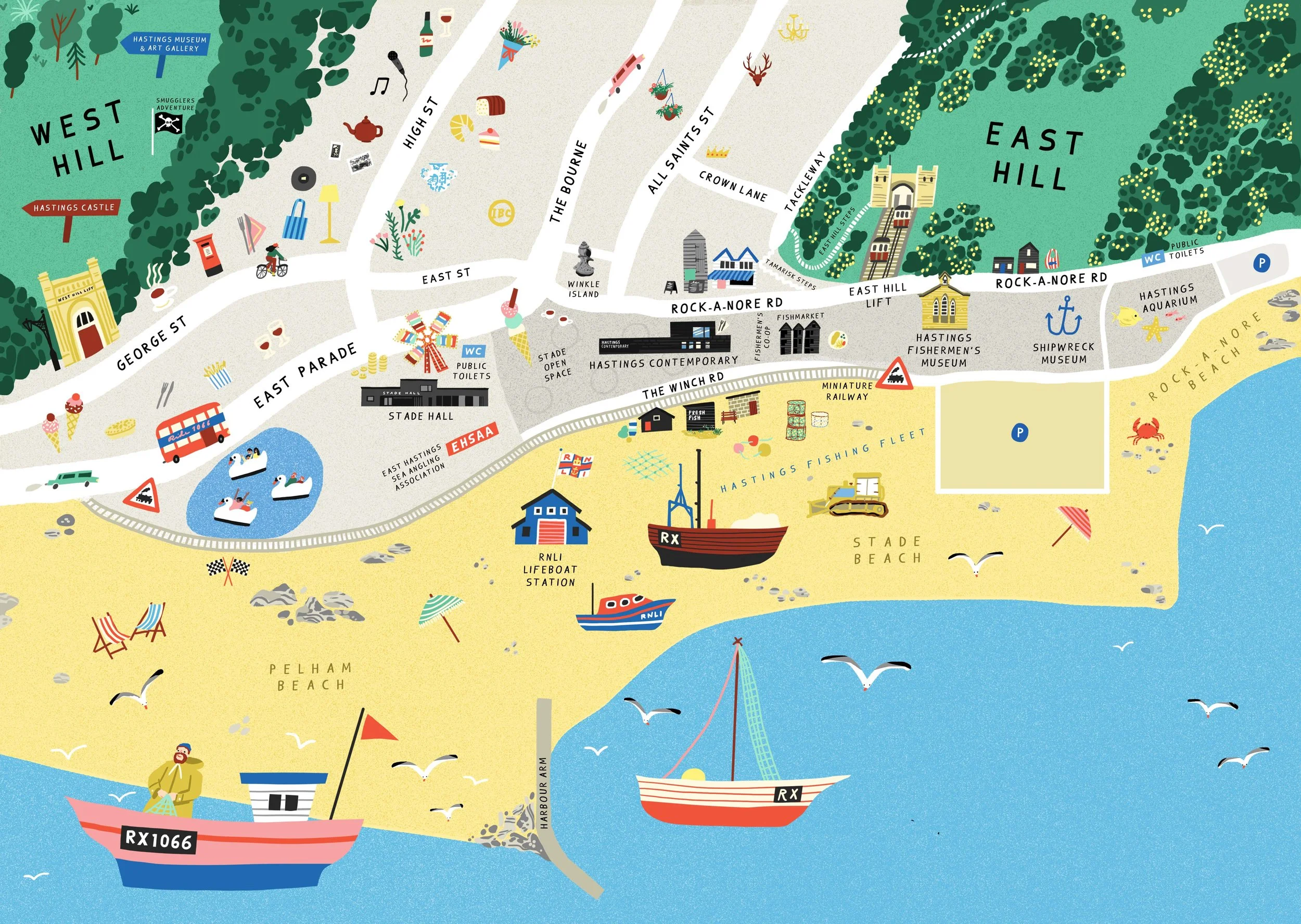

Map of Hastings Old Town, specifically The Stade, showing beaches, streets, landmarks, and attractions including Hastings Castle, Hastings Museum, Fishmarket, Stade Beach, Pelham Beach, and various boats and seagulls.
HOME

THE STADE

*

THE STADE *

The Stade is a historic shingle beach in Hastings Old Town which has been the traditional landing place for the town’s fishing fleet for more than a thousand years. The term ‘stade’ is a Saxon term meaning ‘landing place’.

HOME

THE FLEET

Hastings has a beach-launched artisanal fleet of small boats under 10m, carrying on a long tradition of day boat fishing which, with restricted catching capacity, means it operates in an environmentally sustainable way. Normal fishing practice in this mixed fishery avoids discards. Rigorous monitoring of Marine Stewardship Council certified Dover sole, herring and mackerel since 2005 ensured good practice. The Hastings fishery resource is in good health and fishermen actively support an extended local Marine Protection Area. 

The artisanal nature of the fleet is matched by the small-scale, high-quality processing that takes place in Hastings, mainly around smoking and filleting and some shellfish preparation. 

The craftmanship and ingenuity of the fleet is also to be celebrated: the artisanal skills of net making and mending have changed little for hundreds of years, apart from the use of more modern materials. The site itself is full of discoveries – hand-painted signs, flags, upcycled materials.

Illustration of a red and black =boat with 'RX' on the side
Illustration of a boat with a red bottom, white stripe pattern, a yellow circle, and sails with the letters 'RX' on it.
HOME
an illustration of a flying seagull flock

Environment 

Despite significant changes to the beach and coastline over the last century, the circa 25 small boats have made the largest beach-launched fishing fleet in Europe. 

The fleet was one of the first in the UK to be recognised by the Marine Stewardship Council (MSC) and has been involved in numerous EU, university and government-led research projects.

HOME

Net Shops

The site is a living testament to Hastings’ industrial heritage, featuring tall, black Grade II* Listed net shops. These narrow timber sheds were built in the 1800s to accommodate the lack of space on the beach which forced fishermen to create vertical storage for nets and other fishing gear. 

The fishing beach is also home to the winch sheds where nets are mended, boats maintained, and equipment stored. This unique industrial site, along with its many longstanding traditions, has made the Stade a conservation area protected by Hastings Borough Council.

Silhouette of three fishing net huts with peaked roofs, against a dark background.
Stack of three green crab pots or nets
HOME
Illustration of two deck chairs one red and white stripedd the other blue and white striped.

PROJECTS

TIME & TIDE
ORAL HISTORIES ARCHIVE

For over ten years, the Hastings Fishermen’s Protection Society (HFPS) has been working with local artist Mary Hooper, who has had a long association with the community, to record conversations and document the work, traditions, and familial heritage of Hastings’ fishing community. 

Last year, Hastings Contemporary’s funding application to the National Lottery Heritage Fund, in partnership with the HFPS, was successful. This enabled the society and lead artist Mary to continue to compile, catalogue and remaster recordings for both an exhibition and oral history archive which will display and preserve the intangible cultural heritage of one of Europe’s oldest and largest beach-launched fishing fleets.  

At the centre of the project is the compilation of an oral history archive, which will be donated to The Keep in Sussex. The project will also support the production of a local Stade map, a website, a public programme of events, workshops and activities, and a flagship exhibition at Hastings Contemporary. Craftsmanship and heritage of the fishing community has been woven into the exhibitions and programme of events, including exhibition construction, recordings, talks and workshops, ensuring the fishermen’s living culture and experience of life at sea is centred.

LISTEN TO THE ARCHIVE
a flock of seagulls illustration
A blue anchor illustration